Diving into a new language can feel like trying to drink from a fire hose. Faced with endless vocabulary lists, it’s easy to get discouraged. But what if you could unlock 80% of everyday conversation by learning just the most essential french words? This isn’t a gimmick; it’s a proven strategy for learning smarter, not harder.
Applied linguistics professor Stuart Webb found that mastering the 800 to 1,000 most common words (or lemmas) in a language provides a massive shortcut to comprehension. By focusing on this high-frequency vocabulary, you build a solid foundation that lets you understand context, ask questions, and navigate real-world situations with confidence—even if you don’t know every single word.
At a Glance: Your French Word Toolkit
- Strategic Learning: Discover why focusing on the top 100+ high-impact words is your most efficient path to conversational French.
- Grammar Essentials: Quickly grasp the core rules you can’t ignore, like noun gender (
le/la) and the crucialtuvs.vousdistinction.- Categorized Word Lists: Get organized, actionable lists of the most common nouns, verbs, adjectives, and connectors you’ll hear and use daily in France.
- Build Your First Sentences: Learn the simple formula to combine these words into practical phrases for ordering coffee, asking for directions, or making small talk.
- Cultural Context: Understand not just what to say, but how and when to say it to sound more like a local.
The 80/20 Rule of Language: Focus on High-Frequency Words
Before you start memorizing a French dictionary, let’s get strategic. The core of any language is a surprisingly small set of words that do the heavy lifting. Think about English: words like “the,” “be,” “to,” “of,” “and,” and “have” appear constantly. French is no different. By mastering its equivalent core vocabulary, you equip yourself to understand the structure of most sentences.
This approach gives you the building blocks. Once you have a solid grasp of these fundamental french words, you can then begin stringing them together into useful expressions. It’s the difference between memorizing a random list of animals and learning the words needed to say, “Where is the big black dog?” This foundation makes it much easier to Master local French phrases and adapt to any situation you encounter.
Cracking the Code: The Unskippable French Grammar Rules
You don’t need to be a grammar expert to speak functional French, but a few non-negotiable rules will prevent confusion and help you sound more natural.
1. Every Noun Has a Gender: Le or La
In French, every noun is either masculine or feminine. This affects the articles (le/un for masculine, la/une for feminine) and adjectives that accompany it.
- Masculine:
le livre(the book),un homme(a man) - Feminine:
la maison(the house),une femme(a woman)
Pro-Tip: There’s often no clear logic to a noun’s gender. The best practice is to always learn the article (leorla) along with the noun itself. Think of them as a single unit:le-livre,la-maison.
2. The Formal vs. Informal “You”: Vous vs. Tu
This is one of the most important social distinctions in French. Using the wrong one can come across as either rude or strangely intimate.
Tu(informal “you”): Use with friends, family, children, and anyone you’re on a first-name basis with.Vous(formal “you”): Use with strangers, shopkeepers, older individuals, in professional settings, or when addressing a group of people (it’s also the plural “you”).
When in doubt, always usevous. It is the polite and safe default. If a French speaker is comfortable with you usingtu, they will often say,On peut se tutoyer, which means “We can usetuwith each other.”
Your Everyday French Vocabulary: The Top 100+ Words
Here are the foundational words you’ll encounter most, broken down by category. We’ve included simple phonetic guides for trickier pronunciations.
Essential Nouns (Les Noms Essentiels)
| French Word | Gender | English Meaning |
|---|---|---|
| femme | fem. | woman, wife |
| homme | masc. | man |
| ami/amie | m./f. | friend |
| maison | fem. | house |
| monde | masc. | world |
| travail | masc. | work |
| école | fem. | school |
| voyage | masc. | trip, journey |
| livre | masc. | book |
| lumière | fem. | light |
| phrase | fem. | sentence |
People and Pronouns (Les Pronoms)
Pronouns are shortcuts that replace nouns. Instead of saying “The man sees the book,” you say “He sees it.”
| French Pronoun | English Meaning |
|---|---|
| je (j’) | I |
| tu | you (informal) |
| il | he, it (masc.) |
| elle | she, it (fem.) |
| nous | we |
| vous | you (formal/plural) |
| ils | they (masc./mixed) |
| elles | they (fem.) |
Describing Your World: Common Adjectives (Les Adjectifs)
Remember, adjectives must “agree” with the gender and number of the noun they describe. The feminine form often adds an -e.
| Masculine Form | Feminine Form | English Meaning |
|---|---|---|
| petit | petite | small, short |
| grand | grande | tall, big |
| bon | bonne | good |
| mauvais | mauvaise | bad |
| chaud | chaude | hot |
| froid | froide | cold |
| heureux | heureuse | happy |
| triste | triste | sad |
| blanc | blanche | white |
| noir | noire | black |
| simple | simple | simple |
| jeune | jeune | young |
| vieux | vieille | old |
Example in action: un petit garçon (a small boy) vs. une petite fille (a small girl). |
The Action Words: Must-Know Verbs (Les Verbes)
These are some of the most common verbs. Learning to conjugate them in the present tense is a huge step forward.
| French Verb | English Meaning | Notes |
|---|---|---|
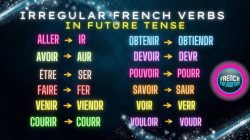
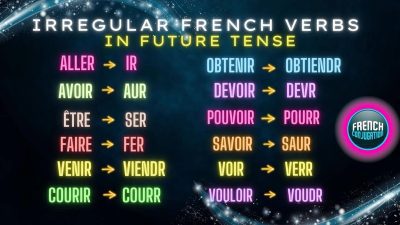
| être | to be | Irregular. Essential for describing. |
| avoir | to have | Irregular. Essential for passé composé. |
| aller | to go | Irregular. Used for near future. |
| faire | to do, to make | Irregular. Extremely versatile. |
| vouloir | to want | Je voudrais = “I would like…” |
| parler | to talk, speak | |
| aimer | to like, to love | |
| voir | to see | |
| prendre | to take | |
| dire | to say, to tell | |
| donner | to give | |
| penser | to think | |
| écrire | to write | |
| lire | to read |
Connecting Your Thoughts: The “Glue” Words
These prepositions, adverbs, and conjunctions are the glue that holds your sentences together.
| French Word | English Meaning | Category |
|---|---|---|
| et | and | Conjunction |
| mais | but | Conjunction |
| avec | with | Preposition |
| pour | for | Preposition |
| dans | in | Preposition |
| à | to, at, in | Preposition |
| par | by, through | Preposition |
| sous | under | Preposition |
| très | very | Adverb |
| beaucoup | a lot, many | Adverb |
| ici | here | Adverb |
| jamais | never | Adverb |
From Words to Conversation: Building Your First Sentences
Knowing the words is only half the battle. The magic happens when you start combining them. French sentence structure is generally similar to English: Subject-Verb-Object.
The Basic Formula: Subject + Verb + Object
Je(I) +vois(see) +la maison(the house). ->Je vois la maison.Elle(She) +aime(likes) +le livre(the book). ->Elle aime le livre.
Adding Detail with Adjectives:
Place the adjective after the noun for most descriptions.Je vois la maisongrande. (I see the big house.)C'est un livreintéressant. (It’s an interesting book.)
Asking Simple Questions:
Use question words at the beginning of the sentence for clarity.Oùest la gare ?(Where is the train station?)Quandest le voyage ?(When is the trip?)Pourquoitu es triste ?(Why are you sad?)C'estcombien?(How much is it?)
Quick Answers to Common French Word Hurdles
Q: Why do French nouns have genders, and how can I remember them?
A: Noun gender is a historical feature of Romance languages, and unfortunately, there’s no simple logic. The most effective method is to learn the article (le or la) with the noun from the very beginning. Some patterns exist (e.g., words ending in -tion are usually feminine), but rote memorization with the article is your most reliable tool.
Q: What’s the biggest mistake beginners make with French words?
A: Pronunciation. French has many silent letters (like the final s in nous or t in petit) and nasal sounds (on, an, en, in) that don’t exist in English. The best way to improve is to listen actively to native speakers—through music, films, or language apps—and mimic what you hear. Don’t be afraid to sound exaggerated at first.
Q: Is it better to use “tu” or “vous” if I’m not sure?
A: Always default to vous. It is the universal sign of respect and politeness. No one will ever be offended if you use vous, but using tu in a formal situation can be seen as overly familiar or even rude. If a French person wants you to use the informal address, they will let you know.
Q: How do possessive adjectives like mon/ma and son/sa really work?
A: This trips up many English speakers. These words agree with the gender of the noun being possessed, not the gender of the owner.
livre(book) is masculine, so it’s alwaysmon livre(my book),ton livre(your book), orson livre(his or her book).maison(house) is feminine, so it’s alwaysma maison,ta maison, orsa maison(his or her house).
Start Speaking French Today, Not “Someday”
The goal of learning these core french words isn’t to achieve perfect fluency overnight. It’s about building a functional toolkit for communication. You can say more than you think with just a small, powerful vocabulary.
Here is your challenge for this week: Learn the top 10 nouns and the verbs être (to be) and avoir (to have). Then, try to form one simple sentence each day. It could be as simple as Je suis heureux (I am happy), J'ai un livre (I have a book), or La maison est grande (The house is big). This small, consistent practice is the key to turning knowledge into a real skill. Bon courage! (Good luck!)