Here is the detailed cluster article, crafted according to your specifications.
Standing in a Parisian boulangerie, the scent of fresh croissants in the air, the only thing between you and that perfect pain au chocolat is a string of unfamiliar sounds. It’s a moment every traveler dreads—the conversational freeze. The good news is you don’t need a dictionary-sized vocabulary to break the ice. A strategic handful of the most common French words is your key to unlocking your first real, rewarding interactions.
This isn’t about memorizing endless lists. It’s about focusing on the high-impact vocabulary that locals use every single day. As applied linguistics professor Stuart Webb notes, learning the 800 to 1,000 most frequent word families is the most effective path to understanding a new language. We’ll focus on the absolute core of that list—the words that do the heaviest lifting.
At a Glance: Your Core Vocabulary Toolkit
In this guide, you’ll discover the practical, no-fluff words you need to start speaking today. Here’s what you’ll walk away with:
- The Building Blocks: The essential nouns, pronouns, and powerhouse verbs that form the backbone of most French sentences.
- Sentence Assembly 101: A simple, step-by-step method for combining these words into basic questions and statements.
- The “Connector” Words: The small but mighty prepositions and adverbs that add meaning and flow to your speech.
- Real-World Cheat Sheets: Themed vocabulary lists for navigating common travel scenarios like ordering food and asking for directions.
- Key Grammar Rules, Simplified: A clear breakdown of core concepts like gender, negation, and the crucial difference between tu and vous.
The 80/20 Rule of French: Focus on High-Frequency Words
Before diving into lists, let’s embrace a powerful shortcut. The Pareto principle applies perfectly to language: roughly 20% of the words are used 80% of the time. Your goal isn’t to know every word for “chair,” but to master the words that appear in nearly every conversation.
Think of these words not as individual items but as versatile tools. The verb avoir (to have) isn’t just one word; it’s a key that helps you say you’re hungry (j’ai faim), you’re 25 years old (j’ai 25 ans), and you have a reservation (j’ai une réservation). By focusing on these core “lemmas”—the base word and its variations—you’re learning smarter, not harder.
Your Foundational Toolkit: The 4 Word Types You Can’t Ignore
Every sentence you build will rely on a few key categories of words. Let’s break down the absolute essentials you need to get started.
The “Who” and “What”: Essential Pronouns & Nouns
These words establish the subject and object of your sentence. They answer the questions “who are we talking about?” and “what are we talking about?”
Pronouns (The “Who”)
Pronouns replace nouns, making speech fluid. The most important distinction for a beginner is between the informal tu (for friends, family, children) and the formal/plural vous (for strangers, elders, in professional settings, or for any group of people). When in doubt, always use vous.
| Pronoun | English Meaning | When to Use |
|---|---|---|
| Je (j’) | I | For yourself |
| Tu | You (singular, informal) | A single friend, a child |
| Vous | You (singular, formal/plural) | A shopkeeper, a group of people |
| Il / Elle | He / She | A single male / female person |
| Nous | We | A group including yourself |
| Ils / Elles | They (masc. or mixed / fem.) | A group of men or mixed / a group of women |
| Common Nouns (The “What”) | ||
| In French, every noun has a gender: either masculine (masc.) or feminine (fem.). This affects the articles (a/the) and adjectives you use with it. The best practice is to always learn a new noun with its article, like un livre (a book) or la maison (the house). |
- la femme – woman, wife
- l’homme (masc.) – man
- un ami / une amie – friend (male / female)
- la maison – house
- le monde – world
- le travail – work, job
- le voyage – trip, journey
- un livre – book
The “Doing” Words: Your First Power Verbs
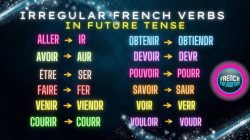
Verbs are the engine of your sentence. If you only learn a few, make them these. They are irregular, meaning their conjugations don’t follow a standard pattern, but their utility is unmatched. We’ll stick to the present tense for now.
1. Être – To Be
This is arguably the most important verb. It describes states of being, nationality, and professions.
- Je suis – I am
- Tu es – You are (informal)
- Il/Elle est – He/She is
- Nous sommes – We are
- Vous êtes – You are (formal/plural)
- Ils/Elles sont – They are
Example:Je suis américain.(I am American.)Vous êtes ici.(You are here.)
2. Avoir – To Have
The second pillar of French verbs, avoir is used for possession and in many essential expressions (idioms). - J’ai – I have
- Tu as – You have (informal)
- Il/Elle a – He/She has
- Nous avons – We have
- Vous avez – You have (formal/plural)
- Ils/Elles ont – They have
Example:J'ai une question.(I have a question.)Elle a un livre.(She has a book.)
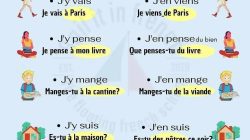
Other must-know verbs: - Aller – to go (
Je vais, I go) - Faire – to do/make (
Je fais, I do) - Vouloir – to want (
Je veux, I want) - Pouvoir – to be able/can (
Je peux, I can) - Parler – to speak (
Je parle, I speak) - Prendre – to take (
Je prends, I take)
The “Describing” Words: Adding Color with Adjectives
Adjectives bring your nouns to life. In French, they usually come after the noun and must “agree” with it in gender and number. For a masculine noun, use the base form. For a feminine noun, you often add an -e.
- grand / grande – big, tall
- petit / petite – small
- bon / bonne – good
- mauvais / mauvaise – bad
- chaud / chaude – hot
- froid / froide – cold
- heureux / heureuse – happy
- triste – sad (same for both genders)
- rouge, bleu, vert, jaune – red, blue, green, yellow (colors)
Example:un petit café(a small coffee) vs.une petite maison(a small house).
The “Connector” Words: The Glue of Language
These small words are the unsung heroes. They connect ideas and give sentences direction and meaning.
- à – to, at, in
- de – of, from
- et – and
- avec – with
- pour – for
- dans – in, inside
- sur – on
- sous – under
- mais – but
- pas – not (used in negation)
- très – very
- beaucoup – a lot, much, many
From Words to Sentences: Your First Conversational Lego Set
Knowing words is one thing; using them is another. Let’s assemble them into functional sentences.
Step 1: Start with a Subject + Verb
This is the simplest possible sentence.
Je parle.(I speak.)Il est ici.(He is here.)
Step 2: Add an Object or Detail
Expand your sentence with a noun or adverb.Je parle français.(I speak French.)Nous avons une table.(We have a table.)C'est très bon.(It is very good.)
Step 3: Make it Negative withne...pas
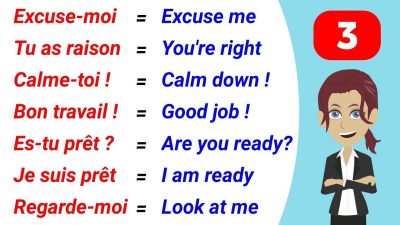
To negate a sentence, you “sandwich” the verb with ne and pas.Je parle français.->Je **ne** parle **pas** français.(I don’t speak French.)Je suis prêt.(I am ready.) ->Je **ne** suis **pas** prêt.(I am not ready.)
Once you’re comfortable forming these basic statements and negations, you can begin stringing them together into more complex dialogues. Our complete guide offers a wider array of conversational scripts to help you Speak French like a local and navigate those longer back-and-forths.
Your “In the Wild” Word Kit: Themed Vocabulary for Real Situations
Let’s put these common french words into action with vocabulary for scenarios you’ll actually encounter.
At the Café or Restaurant
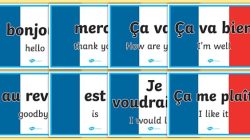
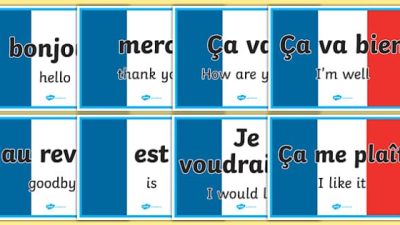
- Bonjour/Bonsoir – Hello (daytime) / Good evening
- Une table pour deux, s’il vous plaît. – A table for two, please.
- Je voudrais… – I would like… (the polite way to order)
- …un café / un thé / un verre de vin. – …a coffee / a tea / a glass of wine.
- L’addition, s’il vous plaît. – The bill, please.
- Merci / De rien. – Thank you / You’re welcome.
- Délicieux! – Delicious!
Navigating the City
- Où est…? – Where is…?
- …la gare? – …the train station?
- …les toilettes? – …the restrooms?
- …la rue de Rivoli? – …Rivoli street?
- À gauche / À droite / Tout droit – To the left / To the right / Straight ahead
- C’est loin? / C’est près? – Is it far? / Is it near?
- C’est combien? – How much is it?
When You’re Stuck or in Trouble
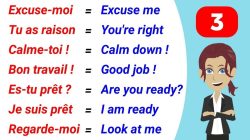
- Excusez-moi. – Excuse me.
- Je ne comprends pas. – I don’t understand.
- Je ne parle pas bien français. – I don’t speak French well.
- Pouvez-vous parler plus lentement? – Can you speak more slowly?
- Je suis perdu(e). – I am lost. (Use
perduif you’re male,perdueif you’re female). - Au secours! – Help! (For emergencies).
Common Questions & Pitfalls (Your Quick-Fire FAQ)
Navigating your first conversations comes with a few common hurdles. Here are quick answers to the most frequent questions.
Q: What’s the biggest mistake beginners make with French words?
A: Two things stand out: ignoring noun gender and mixing up tu and vous. Forgetting gender leads to grammatical errors that can confuse a native speaker (e.g., saying le maison). Using tu with a stranger can be perceived as rude. Always default to vous until someone invites you to use tu.
Q: How do I know if a noun is masculine or feminine?
A: There’s no foolproof rule, which can be frustrating. However, some endings are good clues (e.g., nouns ending in -tion or -sion are usually feminine, while those ending in -isme or -age are often masculine). The most reliable method is to learn the article (un/le or une/la) with every new noun.
Q: What’s the fastest way to memorize these common french words?
A: Consistency beats intensity. Aim for 20-30 minutes of practice daily. Use digital flashcard apps like Anki or Quizlet that use spaced repetition. Most importantly, create context. Instead of just memorizing livre (book), learn J'aime lire un bon livre (I like to read a good book).
Q: Pronunciation is intimidating. Where should I focus?
A: Don’t aim for perfection, aim for communication. Focus on three key areas first:
- Nasal sounds:
on,en,an, andinare sounds made through the nose, unlike in English. - Silent final letters: The final
-s,-t, and-eare often silent (e.g., petit is pronounced “puh-tee”). - The French ‘R’: It’s a sound made in the back of the throat, almost like a light gargle. Listen to native speakers and imitate them.
Your 7-Day Kickstart Plan to Your First Conversation
Feeling overwhelmed? Don’t be. Here is a simple, actionable plan to get you started. Spend 20 minutes on each day’s task.
- Day 1: Greetings & Pronouns. Master saying Bonjour, S’il vous plaît, Merci, and the pronouns Je, Vous, and Il/Elle.
- Day 2: Master Être (to be). Learn to say “I am,” “You are,” and “He/She is.” Practice with adjectives:
Je suis heureux,Vous êtes américain. - Day 3: Master Avoir (to have). Learn to say “I have” and “You have.” Practice with nouns:
J'ai un livre,Vous avez une question. - Day 4: Your First 5 Nouns. Learn 5 common nouns with their genders:
un café,la maison,un ami,une question,le travail. - Day 5: Learn Negation. Take the sentences from Days 2-4 and make them negative using
ne...pas.Je ne suis pas heureux. - Day 6: Ask a Question. Practice the most useful question format:
Où est...?(Where is…?). Combine it with your nouns:Où est la gare? - Day 7: Put it all together. Mentally role-play a simple scenario. Walk through ordering a coffee in your head: “Bonjour. Je voudrais un café, s’il vous plaît. C’est combien? Merci!”
This small core of words is your foundation. They won’t make you fluent overnight, but they will give you the confidence to open your mouth, make a connection, and turn a simple trip into a genuine experience. Every conversation, no matter how small, is a victory. Bonne chance! (Good luck!)