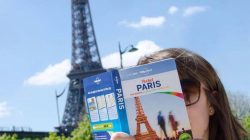
Walking into a Parisian boulangerie, the scent of fresh croissants in the air, you want to order one. But the words get stuck. This moment, repeated in cafés, shops, and train stations, is where a little preparation in the french language for travel transforms a good trip into a great one. It’s not about becoming fluent overnight; it’s about connecting with people, showing respect, and navigating your vacation with a newfound confidence that unlocks a more authentic side of France.
At a Glance: Your Key Takeaways
- Master the “Politeness Quartet”—four essential words that open doors everywhere in France.
- Learn a simple pronunciation framework to make yourself understood, even with a beginner’s accent.
- Discover situation-specific phrases for dining, transportation, and shopping that cover 90% of your interactions.
- Understand the cultural context behind greetings that can make or break a first impression.
- Get a simple, 15-minute-a-day practice plan to build confidence before you even pack your bags.
The Foundation: More Than Words, It’s About Respect
In many English-speaking cultures, we often start a conversation with the request itself—”Can I get a coffee?” or “Where is the bathroom?” In France, this can come across as abrupt or even rude. The cultural expectation is to first acknowledge the person. This is where your language journey begins.
Learning a few key phrases isn’t just a practical tool; it’s a gesture. It tells the shopkeeper, the waiter, or the person on the street, “I respect your culture, and I’m making an effort.” That effort is almost always rewarded with a warmer smile, more patient service, and a more genuine interaction.
The “Politeness Quartet”: Your Passport to Positive Interactions
If you only learn four phrases, make them these. They are the non-negotiable cornerstones of daily interaction in France.
- Bonjour (bon-zhoor) – Hello / Good day
This is your golden key. You say it when you enter any shop, café, or office. You say it to the bus driver, the hotel receptionist, and anyone you ask for help. ForgettingBonjouris the single biggest cultural misstep a tourist can make. In the evening (after roughly 6 PM), switch to Bonsoir (bon-swahr). - S’il vous plaît (seel voo pleh) – Please
Attach this to every single request, no matter how small. “Un café, s’il vous plaît.” “L’addition, s’il vous plaît.” It softens any demand and shows politeness. The informals'il te plaîtis for friends, family, and children—as a tourist, stick with the formalvousform. - Merci (mehr-see) – Thank you
Simple, essential, and universally understood. Use it often. For extra emphasis, you can say Merci beaucoup (mehr-see bo-koo) for “Thank you very much.” - Au revoir (oh ruh-vwahr) – Goodbye
Just as you sayBonjourupon entering, you sayAu revoirwhen you leave. It closes the interaction politely.
Case Snippet: Imagine two tourists entering a small cheese shop in Lyon. Tourist A walks to the counter and points, “I want that one.” Tourist B walks in, makes eye contact with the shopkeeper, and says, “Bonjour, monsieur,” before looking at the cheese. Tourist B will almost certainly receive a friendlier, more helpful experience. That one word makes all the difference.
The “Survival Six”: Your Practical Toolkit for Navigation
Once you’ve mastered basic politeness, these six phrases will help you handle the most common travel situations, from ordering food to finding your way. They are the functional building blocks of the French language for travel.
- Je voudrais… (zhuh voo-dray) – I would like…
This is the most versatile phrase you can learn. It’s far more polite than “Je veux” (I want). You can use it for anything: - Je voudrais un croissant. (I would like a croissant.)
- Je voudrais une table pour deux. (I would like a table for two.)
- Je voudrais un billet pour Paris. (I would like a ticket for Paris.)
- Où sont les toilettes? (oo sohn lay twah-let) – Where is the bathroom?
Arguably the most critical travel phrase in any language. - Combien ça coûte? (kom-byan sa koot) – How much does it cost?
Essential for markets, flea markets (brocantes), and any shop where prices aren’t clearly marked. - L’addition, s’il vous plaît. (la-dee-syon, seel voo pleh) – The check, please.
In France, waiters will not bring the bill until you ask for it. Lingering over a finished meal is common, so you must signal that you’re ready to leave with this phrase. - Parlez-vous anglais? (par-lay voo zahn-glay) – Do you speak English?
Asking in French first is a sign of respect. Even if the person does speak English, they will appreciate the courtesy of you starting in their language. - Je ne comprends pas. (zhuh nuh kom-prohn pah) – I don’t understand.
This is an honest and useful response when someone speaks too quickly or uses vocabulary you don’t know. It often prompts them to slow down, use gestures, or find a simpler way to communicate.
These core phrases are your starting point. As you get comfortable, you’ll see how they fit into the broader tapestry of communication and can help you Unlock better vacation experiences on a deeper level.
Sounding Right: A Traveler’s Guide to French Pronunciation
Fear of mispronunciation stops many travelers from even trying. But here’s the secret: the French don’t expect you to sound like a native. They just need to understand you. Focusing on a few key sounds will dramatically improve their ability to do so.
Taming the Tricky Sounds
- The French “R”: Forget the hard, rolled “R” of Spanish or Italian. The French “R” is a soft, throaty sound produced in the back of the mouth. Think of it as a light gargle or the sound of clearing your throat very gently. Practice with words like
BonjourandMerci. - Nasal Vowels (on, an, in): These sounds don’t exist in English. To approximate them, try saying the vowel while imagining a bit of air is escaping through your nose.
on(in bon) sounds like the “on” in “song,” but don’t close your mouth at the end.an/en(in maman or lentement) is a very open “ah” sound made with the nose.in(in vin) sounds like the “an” in “sang,” but with a smile.- The Silent Letters: A common rule of thumb is that final consonants are often silent. For example, in
trop(too much), the “p” is silent. Inpetit(small), the final “t” is silent. Don’t stress about the exceptions; just being aware of this general rule will help.
Your 15-Minute Daily Practice Plan
Consistency is more important than intensity. A little practice each day leading up to your trip will build muscle memory and confidence.
| Day of the Week | Focus Area (15 minutes) | Actionable Tip |
|---|---|---|
| Monday | The Politeness Quartet | Use a YouTube video of a native speaker. Listen to each phrase 5 times, then repeat it out loud 5 times. Focus on the rhythm. |
| Tuesday | The Survival Six | Write the phrases on flashcards. Practice saying them while doing another task, like making coffee. |
| Wednesday | Dining & Food Phrases | Practice ordering a classic French meal: “Bonjour. Je voudrais le plat du jour et un verre de vin rouge, s’il vous plaît.” |
| Thursday | Numbers & Shopping | Learn to count to 20. Practice asking “Combien ça coûte?” while looking at objects around your house. |
| Friday | Directions & Transport | Learn à gauche (left), à droite (right), and tout droit (straight ahead). Practice asking, “Où est la station de métro?” |
| Saturday | Emergency Phrases | Review Au secours! (Help!) and J'ai besoin d'un médecin (I need a doctor). Hopefully, you’ll never need them. |
| Sunday | Review & Roleplay | Go through all your flashcards. Pretend you are at a market or in a café and have a mini-conversation with yourself. |
Context is King: Phrases for Specific Scenarios
Knowing the right phrase is only half the battle. Knowing when to use it is just as important.
Ordering with Confidence at a Restaurant
A typical restaurant interaction is a perfect place to practice.
- Getting a Table: “Bonjour, une table pour deux personnes, s’il vous plaît.” (Hello, a table for two people, please.)
- Ordering Drinks: When the waiter arrives, you can say, “Je voudrais de l’eau, s’il vous plaît.” (I’d like water, please.) Specify une carafe d’eau for free tap water or de l’eau plate/gazeuse for bottled still/sparkling water.
- Ordering Food: “Comme entrée, je voudrais… et comme plat principal…” (For an appetizer, I’d like… and for the main course…) Or simply point to the menu and use the powerful “Je voudrais ça.” (I’d like that.)
- Finishing Up: “L’addition, s’il vous plaît.” (The check, please.)
Navigating a Market or Boulangerie
Markets are a sensory delight, and a few words can make the experience even better.
- un/une… – a/an
- deux cents grammes de… – 200 grams of…
- une tranche de… – a slice of…
- C’est tout, merci. – That’s all, thank you.
Scenario: Buying a baguette.
You: “Bonjour, madame.”
Baker: “Bonjour.”
You: “Je voudrais une baguette, s’il vous plaît.”
Baker: “Ce sera tout?” (Will that be all?)
You: “Oui, c’est tout, merci.”
Quick Answers: Clearing Up Common Concerns
Common Questions About Using French on Your Trip
Q: Will the French be rude if my accent is terrible?
A: This is a persistent myth. In reality, any genuine attempt to speak French is seen as a sign of respect and is almost always appreciated. If someone switches to English, they are usually trying to be helpful, not critical. Don’t be discouraged!
Q: Is it better to just start in English if I think they speak it?
A: No. Always, always begin with “Bonjour.” It is the most important word you can learn. After that initial greeting, you can politely ask, “Parlez-vous anglais?” Starting immediately in English, especially outside of major tourist hubs, can be perceived as arrogant.
Q: How many phrases do I realistically need to learn?
A: You can have a wonderful, effective trip with just 10-15 core phrases. Focus on the “Politeness Quartet” and the “Survival Six” from this guide. The goal is connection and basic navigation, not fluency. Quality over quantity is key.
Q: What is the single biggest language mistake tourists make?
A: Without a doubt, it’s failing to greet a shopkeeper or employee with “Bonjour” upon entering an establishment. In France, a shop is seen as an extension of someone’s home. You wouldn’t walk into a person’s house without saying hello, and the same logic applies here.
Your First Step to a More Authentic French Vacation
Learning the French language for travel is not an academic exercise; it’s a practical skill that pays immediate dividends in the quality of your vacation. It turns transactional moments into human connections and transforms you from a passive observer into an active participant in French culture.
Don’t feel overwhelmed. You don’t need to buy a massive textbook or enroll in a lengthy course. Start today. Pick just five phrases from this guide—perhaps Bonjour, Merci, S'il vous plaît, Je voudrais, and Au revoir. Write them on a sticky note. Say them out loud a few times. In the time it takes to drink your morning coffee, you’ll have laid the foundation for a richer, more memorable, and deeply rewarding trip to France.