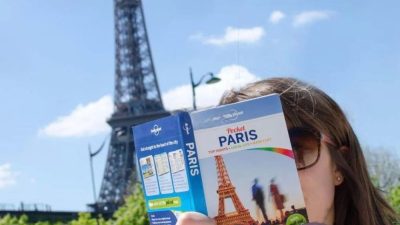
Picture this: you walk into a Parisian boulangerie, the air thick with the scent of warm butter and caramelized sugar. You point at a croissant, mumbling “that one.” The baker, who was just smiling warmly at the customer before you, gives you a flat, transactional look. Now, imagine walking in and confidently saying, “Bonjour! Je voudrais un croissant, s’il vous plaît.” The entire dynamic shifts. Learning a few common french phrases for travel isn’t just about getting what you want; it’s about connecting with the culture and turning a simple transaction into a pleasant human interaction.
This guide isn’t a textbook. It’s a practical toolkit of the essential phrases you’ll actually use, from ordering coffee to finding your way back to your hotel. We’ll focus on the words that open doors, show respect, and make your journey smoother and more memorable.
At a Glance: Your French Phrase Cheat Sheet
- Master the Magic Words: Learn why “Bonjour,” “S’il vous plaît,” and “Merci” are non-negotiable for polite interaction in France.
- Navigate with Confidence: Get the simple phrases for asking for directions and understanding the answers.
- Dine Like a Pro: From asking for a table to ordering drinks and paying the bill, we’ll cover the essential restaurant vocabulary.
- Handle Communication Gaps: Know exactly what to say when you don’t understand or need someone to speak more slowly.
- Shop & Travel Smoothly: Learn to ask for prices, buy tickets, and handle basic transactions at markets and stations.
- Avoid Common Pitfalls: Understand key cultural nuances to avoid embarrassing (and sometimes hilarious) mistakes.
The Unspoken Rule: Why “Bonjour” is Everything
Before we dive into lists of vocabulary, let’s talk about the single most important word in your travel arsenal: Bonjour (bohn-zhoor). In the US or UK, we might launch directly into a question with a shopkeeper (“Where are the batteries?”). In France, this is considered abrupt and rude.
Bonjour is more than just “hello”; it’s a cultural key that unlocks the conversation. Always start every single interaction with it—when you enter a shop, approach a ticket counter, or ask a stranger for help. After about 6 PM, switch to Bonsoir (bon-swahr). Failing to do so signals a lack of respect and can result in chilly or unhelpful service. Mastering this one habit is the first step, and as you’ll see, these small efforts truly Unlock better vacation experiences by showing respect for the local culture.
First Impressions: Greetings, Goodbyes, and Basic Politeness
These are the foundational phrases you’ll use dozens of times a day. They are the bedrock of pleasant interactions.
- Bonjour (bohn-zhoor) – Hello (used until late afternoon/early evening)
- Bonsoir (bon-swahr) – Good evening (used from around 6 PM onwards)
- Au revoir (oh ruh-vwahr) – Goodbye (the universal, safe choice)
- Merci (mehr-see) – Thank you
- Merci beaucoup (mehr-see boh-koo) – Thank you very much
- S’il vous plaît (seel voo play) – Please (the formal/standard version you should always use)
- Excusez-moi (ex-kew-zay mwah) – Excuse me (to get someone’s attention)
- Pardon (par-don) – Sorry or Pardon me (for bumping into someone)
When someone thanks you, a common reply is De rien (duh ree-en), meaning “You’re welcome” or “It’s nothing.” For a more formal touch, you might hear Je vous en prie (zhuh voo-zon pree).
Pro Tip: After a transaction, a shopkeeper might say “Bonne journée!” (bun zhoor-nay), which means “Have a good day!” A lovely reply is simply, “Merci, à vous aussi” (Thank you, you too). In the evening, this changes to “Bonne soirée!” (bun swah-ray).
Navigating Your World: Directions and Getting Help
Even with Google Maps, you’ll inevitably need to ask for directions or help. Don’t be shy. Starting with a polite “Bonjour, excusez-moi…” makes people more than willing to assist.
Getting the Conversation Started
The first thing you should do is politely ask if they speak English. It’s a sign of respect not to assume.
- Parlez-vous anglais? (par-lay voo zahn-gleh?) – Do you speak English?
Asking “Where Is…?
This simple structure will get you far. Just plug in the place you’re looking for. - Où est…? (oo eh…?) – Where is…?
- Où est le métro? (Where is the metro?)
- Où sont les toilettes? (Where are the toilets?)
- Où est la gare? (Where is the train station?)
Essential Directional Words
| French Phrase | Pronunciation | English Meaning |
| :— | :— | :— |
| à gauche | ah gohsh | to the left |
| à droite | ah dwaht | to the right |
| tout droit | too dwah | straight ahead |
If you’re truly lost, this phrase is a lifesaver: - Je suis perdu(e) (zhuh swee pehr-doo) – I am lost. (Use the ‘e’ at the end if you are female).
The Café & Bistro Playbook: Ordering with Confidence
Dining in France is a highlight of any trip. Knowing a few key phrases enhances the experience and ensures you get exactly what you want.
Getting a Table and the Menu
- Une table pour deux, s’il vous plaît. (ewn tah-bluh por duh, seel voo play) – A table for two, please.
- La carte, s’il vous plaît? (lah cart, seel voo play?) – The menu, please?
Cultural Insight: In France, la carte refers to the full à la carte menu. Le menu often refers to a fixed-price menu (e.g., entrée + plat + dessert for €25), which is a fantastic value.
Placing Your Order
The most polite and versatile way to order anything is with “I would like…” - Je voudrais… (zhuh voo-dray…) – I would like…
- Je voudrais un café. (I would like a coffee.)
- Je voudrais le steak frites. (I would like the steak and fries.)
- Pour moi… (poor mwah…) – For me… (A slightly more direct but very common way to order.)
The All-Important Drink Order
Be specific about water unless you want to pay for a pricey bottle. - Une carafe d’eau, s’il vous plaît. (ewn kah-raf doh) – A carafe of tap water, please. (It’s free and perfectly fine to drink).
- De l’eau plate (duh loh plat) – Still mineral water (bottled).
- De l’eau gazeuse (duh loh gah-zuhz) – Sparkling water (bottled).
Finishing Your Meal
When you’re ready to pay, you have to ask for the bill. It won’t be brought to you automatically. - L’addition, s’il vous plaît. (lah-dee-syon, seel voo play) – The check, please.
- C’est délicieux! (say day-lee-syuh) – It’s delicious! (A great compliment to give).
Handling Dietary Needs and Allergies
Communicating dietary restrictions is crucial for a safe and enjoyable meal. Be direct and clear.
- Je suis végétarien(ne). (zhuh swee vay-zhay-tah-ree-en) – I am vegetarian. (Add ‘ne’ if you are female).
- Je suis végan(e). (zhuh swee vay-gan) – I am vegan.
- Je suis allergique à… (zhuh swee zah-lehr-zheek ah…) – I am allergic to…
- …aux cacahuètes. (oh ka-ka-wet) – …to peanuts.
- …aux noix. (oh nwah) – …to nuts.
- …aux fruits de mer. (oh frwee duh mehr) – …to seafood.
Shopping and Transportation Essentials
From browsing a market to buying a metro ticket, these phrases cover common transactions.
At a Shop or Market
- C’est combien? (say kom-byen?) – How much is it?
- Je regarde seulement, merci. (zhuh ruh-gard suhl-mon, mehr-see) – I’m just looking, thank you. (Perfect for politely declining help from an eager shop assistant).
- Acceptez-vous les cartes de crédit? (ak-sep-tay voo lay cart duh creh-dee?) – Do you accept credit cards?
Buying Tickets - Je voudrais acheter un billet. (zhuh voo-dray ash-tay un bee-yay) – I would like to buy a ticket.
- Un billet aller simple (un bee-yay ah-lay sam-pluh) – A one-way ticket.
- Un billet aller-retour (un bee-yay ah-lay ruh-toor) – A round-trip ticket.
Quick Answers to Common Questions
Q: What’s the difference between “tu” and “vous”?
A: Vous is the formal/plural “you,” while tu is the informal “you.” As a tourist, you should always default to vous when speaking to anyone you don’t know, regardless of their age. It’s a sign of respect. Using tu with a stranger can be seen as overly familiar or even rude.
Q: I heard you’re supposed to say “si” instead of “oui” sometimes. Why?
A: You use si to answer “yes” to a negative question. For example, if someone asks, “You aren’t coming?” (“Tu ne viens pas?”), and you are coming, you would respond with “Si, je viens” (“Yes, I am coming”). For a simple positive question like “Do you want coffee?”, the answer is just oui.
Q: Is it rude to start speaking in English?
A: It’s not necessarily rude, but it’s far more polite to begin with a simple “Bonjour. Parlez-vous anglais?” This small effort shows you’re not assuming they should cater to you and goes a long way in setting a positive tone for the interaction.
Q: What’s a common phrase mistake tourists make?
A: Be careful with your pronunciation of merci beaucoup. If you rush the “coup” at the end, it can sound like beau cul, which means “nice butt.” Another classic is saying “Je suis excité(e)” to mean “I’m excited.” In French, this phrase has strong sexual connotations. A better way to express enthusiasm is “J’ai hâte!” (I can’t wait!).
When You Don’t Understand
Don’t panic! It’s perfectly okay not to understand everything. Here are the phrases that will help you manage the conversation.
- Je ne comprends pas. (zhuh nuh kom-prahn pah) – I don’t understand.
- Pouvez-vous répéter, s’il vous plaît? (poo-vay voo ray-pay-tay, seel voo play?) – Can you repeat, please?
- Pouvez-vous parler plus lentement? (poo-vay voo par-lay ploo lahnt-mahn?) – Can you speak more slowly?
- Comment dit-on ____ en français? (kom-mon dee-ton ____ on fron-say?) – How do you say ____ in French?
Your First-Day French Mission
Feeling overwhelmed? Don’t be. You don’t need to be fluent to make a difference. The goal is connection, not perfection.
Start small. On your first day, give yourself three simple challenges:
- The Entry Rule: Say Bonjour every single time you walk into a shop, café, or museum.
- The Coffee Order: Order your first coffee or pastry using “Je voudrais… s’il vous plaît.”
- The Polite Exit: Thank the person with “Merci, au revoir” and add a “bonne journée” if you’re feeling confident.
By mastering these simple exchanges, you’re doing more than just translating words. You’re participating in the culture, showing respect, and building a foundation for a richer, more authentic travel experience. Every small effort will be noticed and appreciated, turning your trip from good to truly unforgettable.