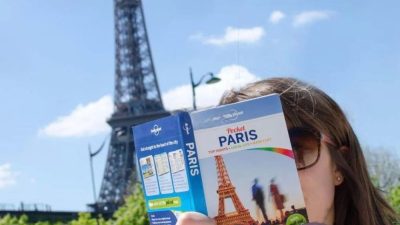
You’re standing in front of a Parisian boulangerie, the scent of warm croissants hanging in the air. You know what you want, but a wave of anxiety hits. How do you ask for it? This moment is where a little knowledge of french for travelers shifts from a “nice-to-have” to a game-changer, turning a transactional moment into a genuine connection. Arming yourself with a few key phrases doesn’t just help you get by; it unlocks a richer, more respectful, and more memorable travel experience.
At a Glance: Your French Phrase Cheat Sheet
- Master the “Magic Words”: Learn why Bonjour, S’il vous plaît, and Merci are non-negotiable for polite interaction in France.
- Navigate Formal vs. Informal: Understand the crucial difference between vous (formal/plural) and tu (informal) to avoid social missteps.
- Handle Key Scenarios: Get the exact phrases you need for dining out, asking for directions, and navigating public transport.
- Keep Conversations Going: Discover simple phrases to use when you don’t understand, need someone to speak slower, or want to ask a question.
- Pronunciation is Easier Than You Think: Find simple, phonetic guides for every phrase to build your confidence before you even speak.
The Foundation: Unlocking Doors with Politeness
In French culture, politeness is the bedrock of communication. Starting every single interaction with a greeting isn’t just a nicety; it’s a requirement. Entering a shop, approaching an information desk, or even catching a bus driver’s eye—all of these moments must begin with a greeting.
Think of it as a password. Without it, you might be met with a chilly reception. With it, you signal respect and a willingness to engage, and you’ll find people are infinitely more helpful.
The Essential Greetings
These are your absolute must-knows. Practice them until they roll off your tongue.
- Bonjour (bon-zhoor) – “Good day” or “Hello.”
- When to use it: Use this from the morning until late afternoon (around 6 PM). It is your universal key. Use it when entering any establishment—shop, café, museum—and when addressing anyone for the first time.
- Bonsoir (bon-swahr) – “Good evening.”
- When to use it: Once evening sets in, switch from Bonjour to Bonsoir. It serves the same function but is time-of-day appropriate.
- Salut (sah-loo) – “Hi” or “Bye.”
- When to use it: This is strictly informal. Use it only with friends, young people, or people you know well. Avoid using it with shopkeepers, hotel staff, or officials.
The Magic Words of Courtesy
After the greeting, these phrases are your most valuable tools. The difference between the formal “vous” and the informal “tu” is critical in French. As a traveler, the safest and most respectful default is always vous.
- S’il vous plaît (see voo play) – “Please” (formal).
- Literally “if it pleases you.” Tack this onto the end of any request. Un café, s’il vous plaît. (A coffee, please.)
- Merci / Merci beaucoup (mehr-see / mehr-see boh-koo) – “Thank you” / “Thank you very much.”
- Use it generously. When you receive your change, when someone holds a door, when you get directions.
- Excusez-moi (ex-kew-zay mwah) – “Excuse me.”
- Use this to get someone’s attention or to politely squeeze past someone in a crowd.
- Pardon (pahr-dohn) – “Pardon me” or “Sorry.”
- Perfect for when you accidentally bump into someone. It’s also a great way to ask someone to repeat themselves: just say, “Pardon?” with a questioning intonation.
Mastering these basics is the foundation of a great trip. For a complete guide on how this simple effort transforms your vacation, see our guide to Basic French for Tourists.
Keeping the Conversation Afloat When You’re Stuck
Okay, you’ve said Bonjour. Now what? It’s inevitable that you’ll get a rapid-fire French response that you don’t understand. Don’t panic. Having a few phrases to manage the conversation is empowering.
Your Go-To Phrases for Clarity
- Je ne comprends pas. (zhuh nuh kohn-prawn pah) – “I don’t understand.”
- This is a simple, clear, and perfectly acceptable thing to say. No shame in it!
- Parlez-vous anglais? (par-lay voo ahn-glay?) – “Do you speak English?”
- Always ask this after your initial Bonjour. It shows you’re trying, which is a sign of respect.
- Pourriez-vous parler plus lentement, s’il vous plaît? (poor-ee-ay voo par-lay ploo lon-tuh-mon, see voo play?) – “Could you speak more slowly, please?”
- This is a bit longer but incredibly effective. People often slow down and simplify their language, which can make all the difference.
- Comment dit-on ___ en français? (kom-mohn dee-tohn ___ on fron-say?) – “How do you say ___ in French?”
- A fantastic way to learn on the fly. Point to an object and ask.
- Que veut dire ça? (kuh vuh deer sah?) – “What does that mean?”
- Useful when you hear a word you don’t recognize or see it on a sign.
Navigating Your Environment: Directions and Transport
Getting around is a primary concern for any traveler. Whether you’re hunting for the Louvre or just the nearest restroom, these phrases are your lifeline.
Finding Your Way
The most useful phrase for directions starts with Où est…? (“Where is…?”).
- Où sont les toilettes? (oo sohn lay twah-let?) – “Where are the restrooms?”
- Arguably the most important question you’ll need to ask.
- Où est la station de métro la plus proche? (oo eh lah stah-see-ohn duh may-tro lah ploo prosh?) – “Where is the nearest metro station?”
- Où est l’hôtel ___? (oo eh loh-tel ___?) – “Where is the ___ hotel?”
Buying Tickets and Getting Prices
Navigating ticket counters can be intimidating. Here’s how to handle it.
- Je voudrais acheter un billet. (zhuh voo-dray ah-shuh-tay uh bee-yay) – “I would like to buy a ticket.”
- Follow this up with your destination: …pour Paris (…for Paris).
- Un billet aller simple (uh bee-yay ah-lay som-pluh) – A one-way ticket.
- Un billet aller-retour (uh bee-yay ah-lay ruh-tour) – A round-trip ticket.
- C’est combien? / Combien ça coûte? (say comb-bee-an? / comb-bee-an sah koot?) – “How much is it?” / “How much does that cost?”
- The first is slightly more common and casual. Both work perfectly.
| Scenario | What You Need | What You Say |
| :— | :— | :— |
| Train Station | One round-trip ticket to Lyon | Bonjour. Je voudrais un billet aller-retour pour Lyon, s’il vous plaît. |
| Museum | Two adult tickets | Bonjour. Deux billets pour adultes, s’il vous plaît. |
| Local Market | The price of some cheese | Bonjour. C’est combien, s’il vous plaît? |
Conquering the French Menu: Dining with Confidence
French dining is a highlight of any trip. A few phrases can elevate your experience from confusing to delightful. One key cultural tip: in France, you must ask for the check; it won’t be brought to you automatically.
From Seating to Paying
- Une table pour deux, s’il vous plaît. (ewn tah-bluh poor duh, see voo play) – “A table for two, please.”
- La carte, s’il vous plaît. (lah cart, see voo play) – “The menu, please.”
- La carte refers to the full à la carte menu. If you want the daily fixed-price menu (often a great deal), you can ask for le menu (luh muh-new).
- Je voudrais… / Je vais prendre… (zhuh voo-dray / zhuh vay prond-ruh) – “I would like…” / “I’m going to have…”
- Both are polite and effective ways to order. Simply follow with the item from the menu. Je vais prendre le poulet rôti.
- L’addition, s’il vous plaît. (lah-dee-see-ohn, see voo play) – “The check, please.”
- Catching your waiter’s eye and saying this is the standard way to end your meal.
Handling Dietary Restrictions
Don’t let allergies or dietary needs cause you stress. Be direct and clear.
- Je ne peux pas manger… (zhuh nuh puh pah mon-zhay…) – “I cannot eat…”
- …de gluten. (duh gloo-ten) – “…gluten.”
- …de noix. (duh nwah) – “…nuts.”
- …de produits laitiers. (duh pro-dwee lay-tee-ay) – “…dairy products.”
- Je suis végétarien(ne). (zhuh swee vay-zhay-tah-ree-an / -ree-en) – “I am a vegetarian.” (Use the second ending if you are female).
Quick Answers to Common French Phrase Questions
Q: Is it rude to just start speaking English?
A: It can be perceived as rude if you don’t greet them in French first. Always start with a simple, polite Bonjour, excusez-moi. This small gesture shows respect for their language and culture, and you’ll find people are much more willing to help, often switching to English themselves if they can.
Q: What if my pronunciation is terrible?
A: Effort is more important than perfection. The French are often stereotyped as being unforgiving of pronunciation errors, but in reality, a genuine attempt is deeply appreciated. No one expects you to sound like a native. A smile and a good-natured effort will get you very far.
Q: When do I use “tu” instead of “vous”?
A: As a traveler, you will almost never need to use tu. Vous is for strangers, people older than you, groups of people, and anyone in a professional setting (shopkeepers, waiters, hotel staff). Tu is reserved for children, close friends, and family. Stick to vous and you will always be correct and polite.
Q: What’s the deal with “Si”? I thought “Oui” meant yes.
A: Oui (we) does mean “yes.” However, you use Si (see) to answer “yes” to a negative question. For example, if someone asks, “You aren’t coming?” (Tu ne viens pas?), and you are coming, you would reply, “Si, je viens.” It’s a small nuance, but interesting to know.
Your First Three Phrases to Master
Feeling overwhelmed? Don’t be. You don’t need to be fluent to make a positive impression. If you learn nothing else, commit these three to memory. They will handle 80% of your polite interactions.
- Bonjour / Bonsoir: Your key to every interaction. Say it every time you enter a room or approach a person.
- S’il vous plaît: Your tool for every request, from ordering coffee to asking for a shopping bag.
- Merci: Your expression of gratitude. Use it often.
Learning these essentials of french for travelers isn’t about memorizing a dictionary. It’s about showing respect, building bridges, and opening yourself up to more authentic experiences. Your journey will be immeasurably richer for the effort. Bon voyage!